
Resource Hub – Customer Experience Management Strategy
More and more businesses are recognising the value of a customer experience management strategy, especially in today’s customer-driven economy. With customer expectations constantly rising and markets becoming increasingly competitive, the experience a business provides can be a real differentiator, often more influential than the price of products and services.
Improving customer experience (CX) is something that all industries should be prioritising and whether you’re operating in retail, hospitality, health and fitness, entertainment, automotive or healthcare, CX can directly impact long-term success.
In this guide, we have explored what customer experience strategies involve, why they matter, and how to build one that delivers measurable results.

What Is a Customer Experience Management Strategy?
Customer experience (CX) refers to every interaction a customer has with a brand and their thoughts and feelings throughout the customer journey. From the first website visit or phone call to after-care support and repeat purchases, every touchpoint and channel plays a part in the overall experience provided. People often use the terms ‘customer service’ and ‘customer experience’ interchangeably, but they are significantly different and CX is about more than just the level of service provided.
A customer experience management strategy is a structured approach to improving the overall experience throughout the entire customer lifecycle. It includes setting clear goals, identifying areas for improvement, gathering insights and feedback, and continuously making improvements based on data. Tools like mystery shopping and customer surveys are often used to support strategies, ensuring they deliver effective results.
To really make a difference to their CX, businesses need a proactive and data-led approach. Rather than just reacting to issues as and when they arise, identifying pain points and anticipating what problems they may be causing enables solutions to be implemented before customers notice them. Staying one step ahead is the only way to exceed expectations.
Why are Customer Experience Strategies Important?
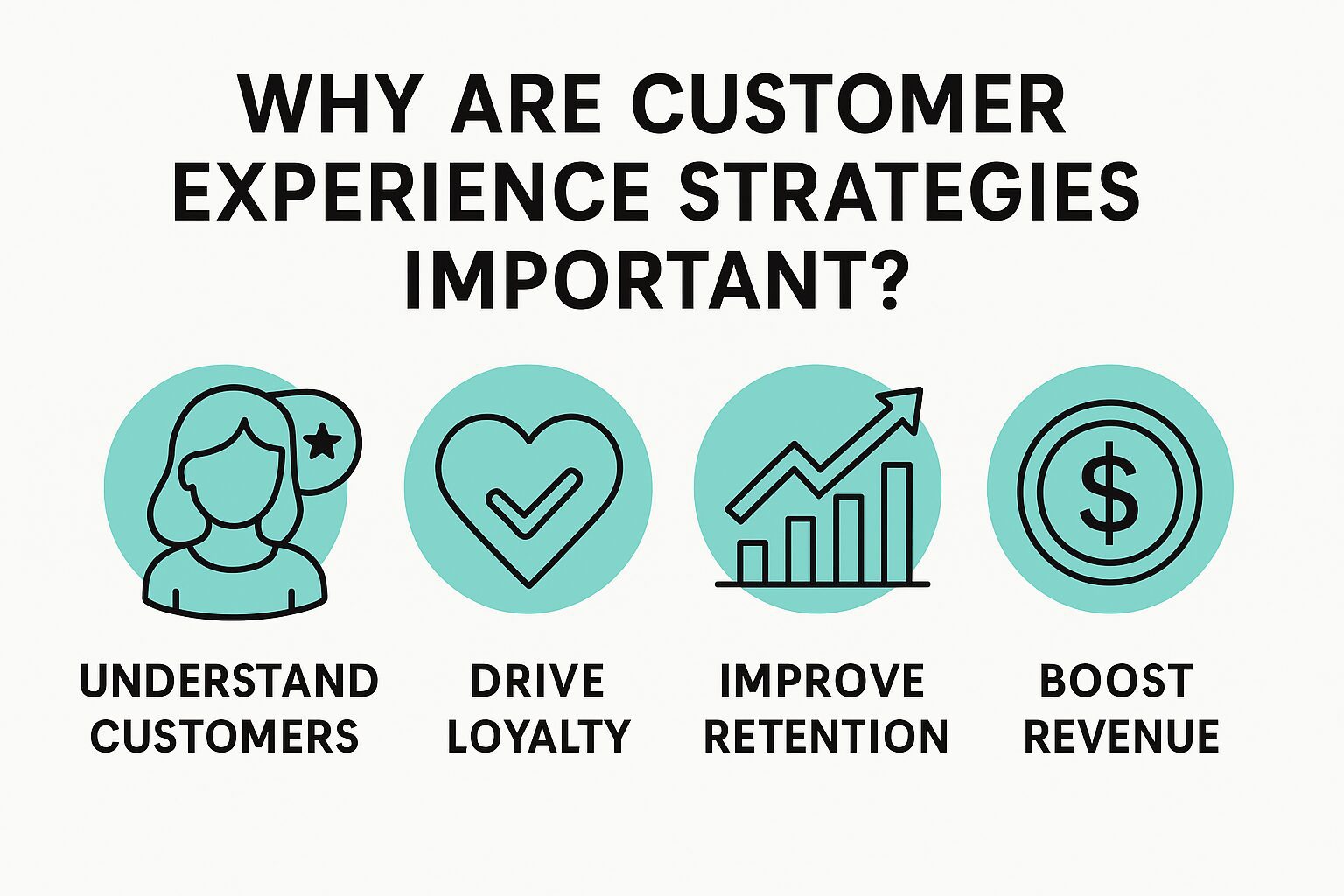
Ultimately, the main purpose of any customer experience strategy is to create a more enjoyable experience for customers. When this is done well, it improves customer loyalty, increases lifetime value and encourages brand advocacy. A good customer experience can provide a competitive advantage and boost your bottom line.
On the other hand, a poor experience can have detrimental effects. It often leads to customer churn, negative reviews and missed opportunities. It can also increase costs, from the costs of acquiring new customers to the costs of fixing reputational damage. Today’s consumers are heavily influenced by other people’s experiences with a brand, so it’s more important than ever to ensure every customer has something positive to say about their experience.
Key Components of a Strong Customer Experience Strategy
For a customer experience strategy to be effective, it needs to cover several key elements;
Define CX Goals
It’s always important to set clear, measurable goals. Whether it’s reducing the number of complaints you get or increasing engagement with your loyalty program, identifying these goals can provide direction for the CX strategy and be used as benchmarks. Well-defined goals ensure that every customer experience initiative aligns with your wider business priorities.


Customer Journey Mapping
You need to identify all customer touchpoints, from online interactions to in-store visits. Mapping the customer journey will help highlight where issues commonly occur and improvements can be made. This process also enables you to view the experience from the customer’s perspective, ensuring you’re focusing on areas that will have the biggest impact.
Mystery Shopping and Customer Feedback
To get a better understanding of how your brand is currently performing, mystery shopping and customer satisfaction surveys can be invaluable. These insights can uncover a broad spectrum of problems, from product and service quality to transaction convenience and accessibility. Learning more about the existing experience can help refine the CX strategy moving forward, making sure nothing goes unnoticed.

Data and Metrics
72% of CX professionals rate their programs as “not very effective”, and this is often because they focus too heavily on broad outcome metrics. While Customer Satisfaction (CSAT) and Net Promoter Score (NPS) metrics are important, they don’t always provide the actionable insights needed to create customer experience strategies.
Instead, the focus should be on elemental metrics. This covers the actionable components of the customer journey, like product quality, service delivery timing and employee interactions, and can help improve the building blocks of customer experience. Elemental metrics will be crucial to develop a targeted customer experience strategy and make informed decisions about CX investments. This approach will help deliver tangible results.
Omnichannel Integration
Consistency is key, and consumers should receive the same positive customer experience whether they’re interacting with your brand online, via phone or email, or in person. Incorporating all channels into the customer experience strategy will ensure that no matter where or how a customer engages with your brand, they enjoy the experience. This will help reduce confusion, build trust and make all customers feel valued.

B2B Customer Experience Strategy – What’s Different?
The overall customer experience will differ depending on whether you’re selling business-to-consumer or business-to-business. For instance, unlike B2C, B2B experiences often involve longer and more complex sales cycles, multiple stakeholders with different needs, and more of an emphasis on trust, transparency and long-term value.
Despite these differences, customer experience is just as important, and a bespoke strategy can be equally as effective. At Proinsight, we work with B2B clients to develop CX approaches that suit the unique demands of their industries and clients. A B2B customer experience strategy can help ensure opportunities aren’t missed due to disappointing interactions throughout the customer journey, and every aspect of the experience is positive.
Integrating Customer Experience into Marketing
Customer experience impacts all aspects of a business, including marketing strategies. How you interact with your target audience through traditional marketing methods like print, TV and radio advertising, as well as modern methods like digital, social media, email, influencer and affiliate marketing will influence their experience with your brand.
More businesses are now embracing customer experience marketing strategies that focus on building long-term relationships rather than just driving immediate sales. This means aligning your brand messaging with real customer insights and using personalisation in campaigns to ensure they resonate with your target audience. Successful CX marketing ensures that any promises made in campaigns are consistently delivered throughout the customer journey too. This builds trust and strengthens brand reputation.
While typically, marketing campaigns are all about getting new customers or advertising new products, customer experience marketing strategies can boost retention, increase lifetime value and turn satisfied customers into loyal brand advocates.
When and Why to Work with Customer Experience Strategy Consultants
Implementing a successful customer experience strategy without professional support can be challenging. Not only can it be difficult to get honest and unobjective insights into your current CX, but knowing what changes to make to see a noticeable improvement isn’t always easy.
Working with customer experience strategy consultants can provide you with valuable external support, especially when in-house resources are limited or there are internal blind spots. Consultants will have an unbiased and structured approach, helping to deliver lasting change. They can design and implement customer experience strategies that lead to tangible outcomes, making any investment worthwhile. If you’re considering investing time and money into improving customer satisfaction, a CX strategy consulting service is a great place to start.


There will be a few clear signs that you could benefit from some expert support too, such as;
- Low repeat purchase rates
- High customer churn
- Regular complaints or negative reviews
- Limited word-of-mouth or referrals
- Poor engagement with marketing campaigns
- High product return or refund rates
So, don’t hesitate to contact our team at Proinsight to find out more about how we can assist you with improving your CX.
Future Trends in Customer Experience
Customer expectations are constantly evolving, and so should your CX strategy to continue providing the best experience possible. Trends come and go in all industries, but staying up-to-date with customer experience trends is something you shouldn’t overlook. It’s anticipated that the future of CX will be influenced by things such as;
AI and Predictive Analytics – Brands will use machine learning to anticipate customer needs before they arise, enabling them to be one step ahead.
- Hyper-Personalisation – With the help of real-time data, it will be easier to deliver a highly tailored experience to every customer, new or existing.
Chatbots – Support teams will benefit from chatbots that provide instant, 24/7 assistance to customers, ensuring needs are always being met.
Augmented and Virtual Reality – From immersive product demos and virtual tours to enhanced customer service, AR and VR will support all aspects of the customer journey.
Creating a Customer Experience Management Strategy
Ultimately, a robust customer experience management strategy is essential for businesses that want to not only stand out from the crowd, but also build lasting customer relationships and drive sustainable growth. Whether you’re looking to improve your CX for the first time or you want to refine your existing approach, our team at Proinsight is here to help you.
You can get in touch today to discuss your specific needs in more detail, and we will be happy to answer any questions you may have. We can assure you that our comprehensive approach will get results and with continuous evaluation, we will help you maintain high standards. Our many years of experience working across a range of industries puts us in the perfect position to support you, and we understand the importance of customer centricity.
Fill in the relevant contact form below and one of our team will call at a time that suits you – to find out how Proinsight can help you.
Fields marked with a * are required

